
.png)
EDUCATOR + BLOGGER
WORKSHOPS
COMIC STRIP.

Literacy does not just stop at being able to read and write, it also includes technological literacy (Hughes, 2020). Our students must be able to participate in a knowledge driven society where they are able to understand and think critically about the complex issues that are happening in our society today (Hughes, 2020). Social media can be a used as a fun resource to teach technological literacy, but it does have its downfalls. It is important that we teach our students to engage in critical media literacy so that they are able to recognize fake news (Hughes, 2020).
I was inspired by the idea of #twittertrolls because as someone with a twitter account, I see how people are being trolled every day. Twitter trolls are everyday people. They are relentless and they can really break someone down. Social media can bring us together, but it can also tear us apart (Hughes, 2020). Twitter trolls are the perfect example to illustrate how social media can be used tear us apart.
My hope is that this comic strip illustrates the impact of trolling and challenges your thinking about the impact of social media. One of my goals as a teacher is to teach students how important it is to know how to use social media responsibly, and to help students develop the critical thinking skills to challenge what they see on social media as it relates to them so that they will be able to recognize twitter trolls and fake news.
Reference: Hughes, R. (2020/in review). Fake news, fear, and prejudice in the post-truth era. In The Encyclopedia of Critical Media Literacy. Oxford, UK: Oxford University Press.
CITIZEN DOCUMENTARY.
A Citizen documentary provides a powerful way to capture the most controversial and pivotal moments in our society. It has the potential to teach students about culture, history, social justice, and so many other important themes as a way of seeing and understanding our world (Hughes, 2019). It serves as an important role to our society in that it is a visual way to celebrate diversity in acknowledging compassion for others in society (Hughes, 2019). My citizen documentary displays my culture and celebrates an important cultural milestone that happens in every Congolese girl's life.
Congo, Kinshasa is where my entire family is from. It is very rich in culture, traditions, and customs. We value our traditions and we hold them very close in order ensure that they continue to be passed down from generation to generation. This cultural event will teach you a little about one of our most sacred ceremonies. I hope you are able to learn about the value of culture, traditions, and why they are important. This is huge part of my identity. My hope is that this short video allows you to consider your own culture and traditions, and encourages you to think about why they are important to you.
Reference: Hughes, R. (2019). Citizen documentary: A method to document and mobilize social justice research. In K. Cooper & R. Hughes (Eds.), What does it mean to become worldly? Toronto, Canada: Life Rattle Press.
VISUAL DIARY.

Our whole world changed last year. Quarantine 2020 was a year that no one could have predicted. We were all stuck at home and apps like Instagram became filled with "Quarantine content" (Libby & Fargo, 2020). For many people it was a very difficult and trying time. Isolation is not easy and being quarantined with the entire world shut down definitely affected mental, emotional, and physical health of many people. I was fortunate enough find the things that would get me through the duration of the pandemic. I learned to appreciate nature, which is huge for me because I hated the outdoors before quarantine. I became more active, I cooked new homemade recipes, and I nannied the most wonderful child. Even though there is so much to be stressed about there is also so much to be happy about. I was privileged to be able to capture all these moments during my time in quarantine.
Visual diaries teach us a new way of looking at life in a more rich and complex ways (Libby & Fargo, 2020). Quarantine 2020 forced social media to bring us together as a nation, and the visuals we see from that time have impacted us as we see what others have been doing at home in isolation (Libby & Fargo, 2020). My visual diary offered insight to my view of what was going on in our global condition where each picture posted directly addresses how the impact of quarantine impacted my life. I hope that my visual diary inspires you to try something fun and new in the midst of these unprecedented times. I also hope to challenge students to think about how their inner world connects to our outside would, and encourage them to use that connection show their different experiences through pictures (Libby & Fargo, 2020).
Reference: Libbey, P. & Farago, J. (2020). The world’s great photographers, many stuck inside, have snapped. The New York Times.
MIND MAP.

Mind maps are a great way to deepen student knowledge by presenting a visual that represents their thinking. It can be used to display mastery of new content, promotes collaboration, authenticates new knowledge for real purposes, allows for technological creativity, and it puts students in control of their own learning (Fullan & Langworthy, 2014). Using digital tools like a mind map "helps students build attitudes and confidence through doing purposeful work that will make a difference in the world" (Fullan & Langworthy, 2014).
This mind map illustrates my understanding of special education, mental health, and well being. It details each topic and illustrates how they are all interconnected in some way. What we all can learn from special education is that the presence of of students with exceptionalities in the classroom helps other students understand the idea that everyone communicates differently. This will help both students and teachers challenge their own biases about special education and deepen our understanding about how we make our classrooms more inclusive.
Reference: Fullan, M., & Langworthy, M. (2014). A rich seam: How new technologies find deep learning. London: Pearson (Chapter 4).
CODING.

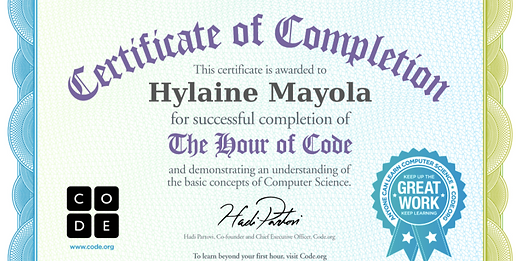
This coding experience was super enjoyable. It was like fitting all the pieces of a puzzle together so that I could see the correct picture. Without fitting every piece of the puzzle together correctly, the picture would be distorted. Young students are capable of learning to code in the same way where children become engaged when there is a possibility to create something real and tangible that can they can share with their peers (Kafai & Burke, 2014). That is exactly how I was able to code this dance party with all the cool synchronous dance moves. Code.org is a great platform to learn how to code games or dances in an hour! This website gives students the opportunity to be creative, innovative, and driven. It allows students to create their own game or dance that they would enjoy, while teaching them skills such as patience, determination, and resiliency. It is a fun activity that can be used in multiple subjects, where students can enjoy and make it their own. Check out the smooth dance party that I coded, and see what students can learn to do in just an hour!
Reference: Kafai, Y. B., & Burke, Q. (2014). Mindstorms 2: Children, programming, and computational participation.